
For your Local Experts call us on 0808 301 8231 or Book A Survey Online
Do I Need to Replaster Damp Walls?
Many properties across Scotland will suffer with damp patches forming on walls, which over time can cause the plaster to deteriorate and skirting boards to become rotten.
While many will assume that the plasterwork must be replaced, sometimes the problem can be caused by condensation and the masonry within the walls is bone dry. Building defects can also cause damp plasterwork, which if repaired, can prevent the problem without the need for replastering. This is why it's important to fully understand the problem causing walls to become damp, before you carry out remedial works.
Condensation causes the surface of walls and ceilings to become damp as excess moisture within a property condenses on the surface, turning into liquid. This is often caused because the wall is a cold bridge, so thermal improvements are required.
Penetrating damp is caused when moisture from outside penetrates into the fabric of a building and through internal plasterwork. It is often caused by rainwater which penetrates through porous masonry walls, or is caused by leaking gutters or blocked drains. If you solve the external issue the problem may disappear without the need for replastering.
That said, if the problem is left untreated, the plasterwork can deteriorate and crumble away from the wall. Damp problems can also lead to other issues such as fungal decay and structural problems. If lateral penetrating damp is present, the masonry will be below the external ground level. Elements of waterproofing and replastering may be required.
Walls affected by rising damp will often need to be replastered. This is because moisture from the ground absorbs hygroscopic salts which rise up through the masonry by capillary action, which can lead to salt efflorescence forming on internal walls and breakdown of the plaster surface. If the plaster is not replaced, it is likely trapped salts will continue to come out of the masonry and affect the plaster finish.
Because replastering is not always required, it is essential that any damp problem is accurately diagnosed in order to avoid unnecessary and costly repairs.
If replastering is required because of contaminated plasterwork, it will be carried out in partnership with damp proofing, specifically to prevent the type of damp causing the problem. If this is not done, the problem could return.
If you are unsure what type of damp is affecting your property, you can have a CSRT/CSTDB qualified surveyor provide you with a damp and timber survey which will outline the type of damp affecting your property, and the next steps involved
Salt Efflorescence and Salt Damage
Salt efflorescence is a white powdery substance that appears most commonly on external walls, but if there is a damp problem, can sometimes appear internally. Salt efflorescence will occur when moisture causes dissolved salts within masonry to migrate to the surface. They are in solution, and once the moisture has evaporated from the surface they become salt crystals.
If a building does not have a functioning damp proof course (DPC), or if it has become bridged internally or externally, groundwater is able to rise up through the masonry by capillary action. A DPC is a physical barrier to prevent moisture rising upwards. It is required because masonry has tiny pores and cracks through which moisture is drawn up through the ground.
When a DPC is missing, bridged or has failed, moisture from the ground will rise up masonry bringing hygroscopic salts to the surface of the wall. The salt residue is left, which causes salt bands to form.
Salt efflorescence can also be caused by penetrating damp, allowing moisture to penetrate into the structure of the building, typically through cracks or missing mortar, or from backed up gutters running down brickwork. This draws natural salts out of the masonry and deposits them on the surface.
It can also be caused by lateral rain penetration of the masonry during periods of heavy rainfall, especially in coastal areas. Regular maintenance and simple remedial repairs will prevent efflorescence caused by penetrating damp, and it will also prevent other issues such as wall tie failure and fungal decay.
Identifying Salt Damage internally
If you spot salty bands that look similar to tide marks, up to a metre above skirting board level, this could indicate a rising damp problem. Rising damp can lead to unsightly damp patches, salt deposits and can even lead to other problems like rotten skirting boards.
Once confirmed as rising damp by a trained and qualified professional, damp proofing will need to be carried out, and the affected plaster may need to be replaced.
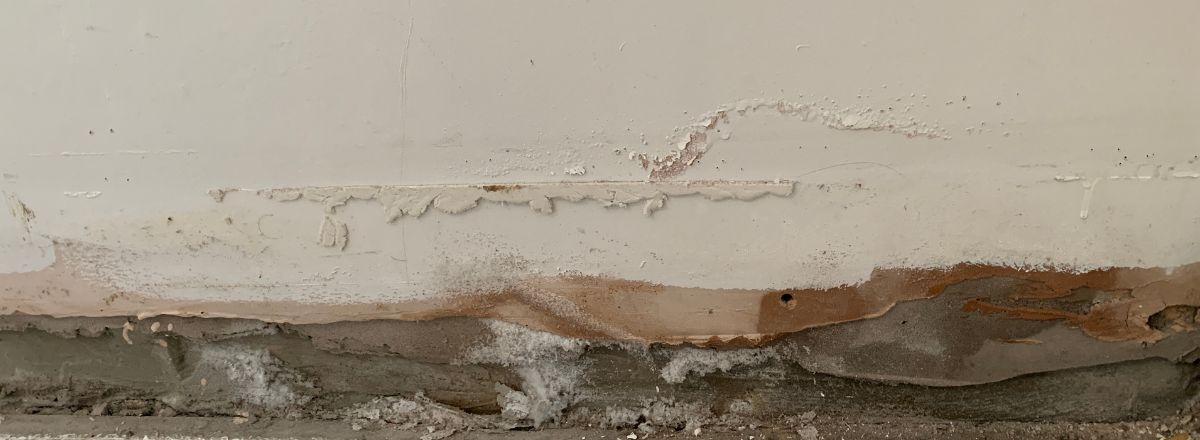
Rising damp can cause hygroscopic salts to form on the surface of walls, which can cause the deterioration of plaster.
Replastering Damp Walls - Process
The most important thing is to correctly diagnose the type of damp causing the problem, otherwise you may carry out unnecessary treatments that do not work. Wise Property Care have a number of qualified surveyors who can provide you with a damp and timber survey, to fully understand the problem affecting your property.
If treatments are required, this will be detailed in the survey report. If you choose to go ahead with the works, a specialist technician will then remove salt contaminated plaster from the wall affected by rising damp, exposing the bare masonry.
While rising damp may appear just above skirting board level, it is important to remove the wall plaster high enough to ensure we get rid of all the salt affected plaster. If not, these salts could appear in the future, giving the illusion of a new rising damp problem. Wise Property Care will carry out replastering 300mm higher than the highest salt stains and to a minimum height of one metre.
A damp proof course can then be installed horizontally into the wall mortar joint above the external ground level. This may differ depending on the external and internal ground levels. While a new damp proof course is installed, the existing masonry will still contain moisture and hygroscopic salts.
This is why when replastering its essential to use a salt resistant plaster. This creates a barrier preventing salts in the masonry from affecting new plasterwork.
At the bottom of the wall the plasterwork will finish just above the installed damp proof course. This prevents a bridge occurring, which allows moisture to bypass the newly installed damp proof course. The gap is covered by the skirting board.
Replastering Damp Walls FAQs
-
Why does Contaminated Plaster need to be Replaced?
The reason plaster contaminated with hygroscopic salts needs to be replaced is because if left untreated, the salts can continue to migrate to the surface and draw moisture from within the internal atmosphere of the property back into the walls.
Even if a new damp proof course has been installed, this will continue as salts migrate to the surface of the wall. This will cause damp patches to appear while the plaster will deteriorate, flake away and pop away from the walls.
When this occurs it is known as salt damp. When walls affected by rising damp that have been replastered with a non remedial or salt inhibited plaster, it is possible for these salts to pass through the new plaster.
This is why it is necessary to replaster the affected areas with a salt retardant plaster when carrying out damp proofing for rising damp, in order to prevent future salt migration.
-
Does Damp Plasterwork Dry Out?
Plasterwork can become saturated with moisture, but in some cases if you remove the source of moisture it will begin to dry out without the need to be replaced. Plasterwork affected by hygroscopic salts however will need to be replaced, as the salts will migrate to the surface and will pull moisture out of the atmosphere, creating damp patches over time.
If the plasterwork has become damp because of a plumbing problem, a faulty appliance (such as a dishwasher or washing machine) or if a building defect has caused a recent damp problem, once this has been repaired the wall should begin to dry out.
The time taken for masonry and plasterwork to dry out will depend on the construction materials, the air temperature inside the property and humidity levels. Typically solid walls will dry out at approximately 25mm (one inch) a month, but this will vary depending on the season.
If you are wanting to speed up the drying process, you can try to increase the heating in the affected areas, while increasing air circulation by opening windows or using a dehumidifier. But care should be taken as this can lead to cracking of the plaster.
Even if damp walls dry out, the damage caused by issues such as rising damp will remain, and could even lead to further damp problems down the line through salts migrating from the brickwork through the plaster. This can cause what is known as salt damp and is why for cases of rising damp, plasterwork needs to be replaced.
-
What types of plaster can be used on damp walls?
While gypsum based backing plasters can be used to replaster damp walls that have deteriorated because of condensation, these should not be used when replastering for a rising damp or penetrating damp problem.
Salt resistant plasters should be used to prevent salts migrating from the masonry through to the surface. These protect the skim coat from damage, while allowing the walls to dry out by evaporation. This means that once the walls are dry you can redecorate without the worry of further damage caused by hygroscopic salts.
When carrying out DIY treatments for rising damp many fail to use a salt resistant plaster after treatment, which ultimately leads to further problems with salt damp in the property, as salts from the masonry migrate through to the surface.
This is why it's important to use a reputable company who can carry out damp proofing correctly, and who will back their work with a long term guarantee.
-
Do Damp Walls caused by Condensation need Replastering?
For damp walls caused by condensation it is not normally required to use a salt resistant plaster, because the inside of the wall will be bone dry. Condensation is caused by excess moisture in the atmosphere condensing on the cold surface of the wall. To prevent this issue you must address the cold bridge by increasing the thermal efficiency of the wall, increasing room temperature to hold more moisture or improve ventilation. Generally, it is best to improve thermal efficiency.
A Thermal Plastering product can be used to create a thermal barrier that prevents the wall becoming a cold spot. This in turn will stop water beading on the wall, increase the thermal efficiency and prevent heat loss, which can help reduce energy bills.
This plastering system uses thin insulating tiles, which means walls can be insulated without costly alterations to skirting boards, windows, covings and radiators.
-
Is Damp Proofing and Replastering messy?
One of the most common questions our surveyors receive is about mess and dust. As treatments for rising damp and replastering require the removal of plaster, and drilling into brickwork, it is unavoidable, so there will be some dust and mess.
Wise Property Care will take precautions to minimise dust and debris, with our technicians leaving your property as tidy as possible once treatments are completed.
Our technicians are equipped with vacuums, floor coverings and sheeting to keep dust and debris to a minimum inside your home
All of our technicians also have Hilti dust extraction units which help remove airborne dust from the atmosphere while hacking off salt contaminated plaster, drilling or cutting timber. These units are designed to create a safer environment for our technicians, but have the add on effect of reducing the amount of dust settling, while reducing the dust particles moving throughout your home.
-
How much does it cost to fix damp walls in Scotland?
Costs involved in treating damp walls will depend on the extent of the problem, the type of damp involved and whether or not a damp proof course is required. Sometimes damp walls do not need to be replastered, which can also impact the price of fixing damp walls.
In order to fully understand the extent of the problem and the necessary treatments involved, we would recommend you have a damp and timber survey carried out to provide you with answers on the exact problem, with treatments designed specifically for your property.
Why Choose Wise Property Care
When you’re worried about a damp problem, you want to use a company with experienced and specialist surveyors - with the right training and knowledge to reach the proper diagnosis.
Wise Property Care have both CSRT (Certificated Surveyor in Remedial Treatments) and CSTDB (Certificated Surveyor of Timber and Dampness in Buildings) qualified surveyors operating from a network of local branches - meaning no matter where you are in Scotland, we have a surveyor local to you.
- Wise Property Care have been fixing condensation and mould problems and building value back into Scottish properties since 1996.
- We have a proven track record working with homeowners, social housing and commercial clients across Scotland, delivering effective preservation solutions while ensuring full compliance with industry regulations and health and safety standards.
- We are proud members of the Property Care Association (PCA), the trade association that governs our industry. This means you can trust you’re getting professional and honest advice, and treatments following the industry best practice.
- Wise Property Care are endorsed by Which? Trusted Trader - meaning our customer service and workmanship has passed rigorous trading standards assessments.


