
For your Local Experts call us on 0808 301 8231 or Book A Survey Online
Damp Proof Plaster
If you are replastering damp walls it's essential that you use the correct products that are designed to deal specifically with the type of damp that was causing the problem. It is also important to solve the damp problem before carrying out replastering.
Penetrating damp, condensation and mould growth will all cause plasterwork to become stained and deteriorate over time, affecting the appearance. But damp proof plaster is not always required to solve these problems. However, if gypsum backing becomes damp it acts like a sponge and can become 'soft' and salty.
Damp proof plaster generally refers to plaster that prevents salt migration, and is typically used for a confirmed rising damp problem. If confirmed to be rising damp, typically a new damp proof course is installed and then damp proof plaster is used to prevent hygroscopic salts trapped within the masonry moving into the new plaster.
Because of this, it's important to accurately diagnose a damp problem before carrying out repairs. This is why we would recommend getting a damp and timber survey.
Wise Property Care have a number of CSRT and CSTDB qualified surveyors operating across Scotland who are on hand to provide advice and recommendations for all types of damp problems.
What are Damp Proof Plasters?
Damp proof plasters are products designed to prevent moisture and salts penetrating through to the internal surface of a wall. They are designed to be breathable and salt resistant to allow the walls to dry out, but prevent surface decorations being damaged by salts. They are typically cement based rather than gypsum based.
These types of plaster are often referred to as renovation plaster, and are a common choice for properties with salt contaminated solid walls or heritage and restoration projects.
What Plaster to use on Damp Walls?
If you are replastering after walls have deteriorated because of a penetrating damp or condensation problem, and the root cause of the issue has been fixed, replastering can take place. If the plaster is still in good condition, you may not need replastering at all.
If condensation is the cause of plaster becoming deteriorated, you may want to use a thermal plastering system. This is because condensation forms on cold walls, which leads to damp patches and mould growth. Increasing the thermal efficiency of the wall can prevent this.
For penetrating damp you must first fix the external source of moisture, either from building defects or porous masonry. If the wall is below ground level, specialist replastering may be required.
Replastering damp walls caused by rising damp will need to be replastered using specialist products which contain a salt retardant additive. This is because ground salts present in the water that has risen up the walls can migrate to the surface of new plasterwork, unless there is a salt inhibitor.
Because not all damp walls require replastering, it is important to fully understand the root cause of the damp problem before carrying out replastering. This can be done by a qualified surveyor through a damp and timber survey.
Preventing Salt Contamination with Salt Resistant Plasters
A salt resistant damp proof plaster, often referred to as renovation plaster is a product specifically designed for the replastering of properties affected by salt contamination in masonry, after a rising damp problem has occurred.
The affected plasterwork is hacked off before a new damp proof course is installed, and then the new plasterwork is applied. The plaster allows the walls to dry out which prevents moisture from being trapped within the structure.
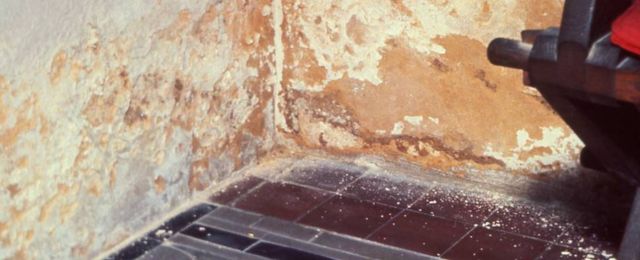
The reason a salt resistant plaster is required is because affected walls will contain hygroscopic salts which were brought up into the masonry from ground water by capillary action. Over time these soluble salts will migrate to the surface, and as the moisture evaporates salty deposits are left. These salt deposits can form large crystals and pop the plaster off the wall.
They will also cause damp patches to reappear as the salts absorb moisture from the air (hygroscopic).
This can cause occupants to think a damp problem has returned, even though damp proofing work has been carried out.
Using Lime plaster to fix Damp Walls
Another common product used in the restoration of listed or heritage buildings is lime plaster, which is often used to fix damp walls.
Lime plaster allows moisture to pass through and evaporate away, because it is permeable, which means walls are able to dry out. This makes it useful for some applications, however it is not able to prevent salt migration. If walls are contaminated with hygroscopic salts caused by rising damp, an application of lime plaster may not stop future deterioration of the surface caused by salt migration.
Lime plaster is often recommended rather than more modern plasters, however its use will depend on the type of property in question, and the damp problem.
Because lime plaster allows moisture to migrate through the walls into the property, it can sometimes lead to condensation problems internally. Originally this would not be a problem in historic properties as windows were single glazed and there were open fire places, but as more modern alterations often reduce draughts, condensation problems can arise.
These problems must be taken into account when replastering your property.
If you are unsure about your next steps, a qualified surveyor can investigate the problem, and offer expert advice and recommendations, including the use of lime plaster in your listed property. Often lime plaster is required as part of the restoration process and is required by the listed building officer.
Waterproof Plaster and Slurries for Walls
Waterproof plasterwork or slurries are often referred to as waterproof tanking, which is a technique used to create a waterproof barrier between high external ground levels and the internal space, which is below the damp proof course level. These are used to prevent moisture penetrating through the masonry due to lateral penetrating damp. These are often used as part of below ground waterproofing systems, known as Type A barrier protection waterproofing.
Waterproof tanking typically uses a cementitious product which is applied directly onto the walls to create a waterproof barrier.
When carrying out tanking it is important to make sure all walls are prepared, with all existing plaster removed and any deteriorated mortar repaired. The wall can then be dusted down to create a sufficient surface for the slurry to bond onto.
Where required, salt and lime inhibitors can be used to prevent hygroscopic salts migrating through masonry into the internal space. This is a common treatment for Scottish properties that are built into hillsides, or that have high external ground levels in rural areas.
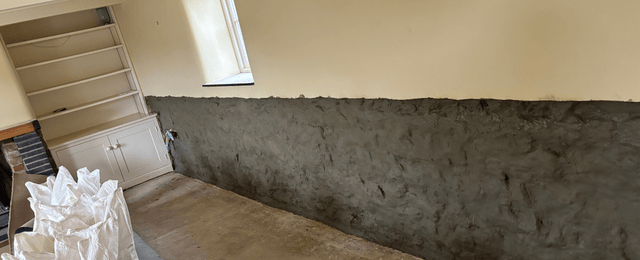
Tanking slurries can be used to create a waterproof barrier that prevents moisture penetrating into the building from high ground levels outside
Damp Proof Plaster FAQs
-
Can mould grow behind plaster on walls?
While typically mould will grow on the surface of plaster because of a condensation issue caused by excessive moisture inside a property, in some cases it is possible that mould grows behind the plaster on walls.
This phenomenon is known as interstitial condensation and is usually caused because the dew point (at which moisture vapour condenses into a liquid) is within the structure rather than on a surface. This can particularly occur where vapour control layers get placed in the wrong position within a structure.Removing the cold bridging plaster can help solve the problem, while effort should be taken to remove excess moisture within the property.
-
Can you stop a damp problem without replacing the plaster?
Whether or not replastering is required will depend on the type of damp affecting the wall. If the wall contains hygroscopic salts, or if the damp problem has caused the plaster to deteriorate, replastering may be required. Once gypsum backing becomes wet, it very often goes 'soft' and salty, so will require removal.
A salt resistant render is required to prevent further problems to prevent salts migrating back through the plaster. This should be carried out in conjunction with a new damp proof course, unless the problem was because a functioning damp proof course was bridged - which has since been resolved.
A condensation problem may not require replastering, however if the wall is causing severe condensation to form, as well as mould growth, thermal improvements may be necessary, such as the application of a thermal plaster system.A damp and timber survey should always be carried out to fully understand the type of damp affecting the property, if timbers have been affected, and to confirm whether or not the plaster needs to be replaced.
Why Choose Wise Property Care?
When you’re worried about damp, mould and condensation in your home, you want to use a company with experienced and specialist surveyors - with the right training and knowledge to reach the proper diagnosis.
Wise Property Care have both CSRT (Certificated Surveyor in Remedial Treatments) and CSTDB (Certificated Surveyor of Timber and Dampness in Buildings) qualified surveyors operating from a network of local branches - meaning no matter where you are in Scotland, we have a surveyor local to you.
Wise Property Care have been fixing condensation and mould problems and building value back into Scottish properties since 1996.
We are proud members of the Property Care Association (PCA), the trade association that governs our industry. This means you can trust you’re getting professional and honest advice, and treatments following the industry best practice.
Wise Property Care are endorsed by Which? Trusted Trader - meaning our customer service and workmanship has passed rigorous trading standards assessments.
We are rated ‘Excellent’ on Trustpilot with over 550 independent customer reviews from across our branches in Scotland.


